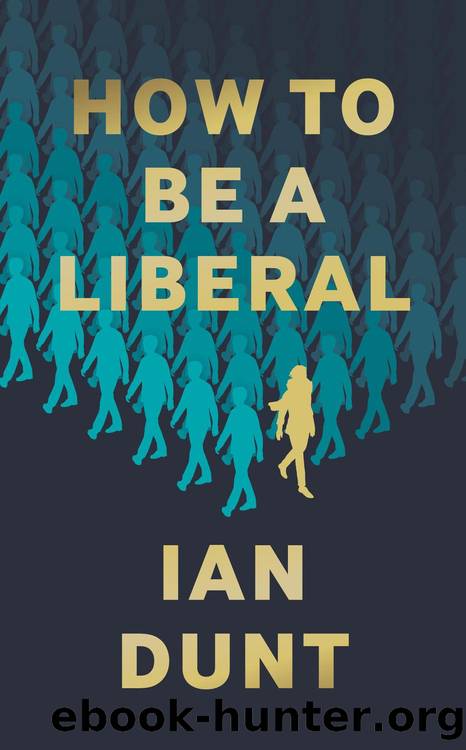
How to Be a Liberal by Ian Dunt
Author:Ian Dunt
Language: eng
Format: epub
Publisher: Canbury Press
Published: 2020-11-15T00:00:00+00:00
By 1941, the bombs had reached England. While they fell, the socialist side of Orwell saw an opportunity for revolution. As it happened, he turned out to be mistaken, but his consideration of the possibility revealed a glimpse of how liberalism could find an accommodation with patriotism. It was an essay called The Lion and the Unicorn.
For a while Orwell had presumed that what people were missing was the church. But now it seemed clear that it was something more powerful. Patriotism, he wrote, had âoverwhelming strengthâ â Hitler and Mussolini had grasped its importance and exploited it in their rise to power. Those who opposed them had not and had paid the price.
Peopleâs need for belonging would never go away, Orwell warned. There would never be a world of Constants, adrift from their nation, cosmopolitan, floating between countries as if they were towns. You could either accept this fact and incorporate it into your political agenda, or leave it to the fascists and let them have a monopoly on peopleâs sense of identity.
Orwell chose the former path. He was not being merely strategic, though. He really felt patriotic. His writings were full of long, loving descriptions of the English countryside. He was constantly concerned with a proper sense of place, with a full appreciation for where he was, whether it was Burma, Spain, Wigan, or Southwold.
Orwellâs English patriotism did not demand conformity. It did not suggest homogeneity. It was an individual expression of admiration that could only have come from someone who had never quite fitted in, with the kind of eyes and attention to detail which that status gave him. He found the love of his country in tiny details â âsolid breakfasts and gloomy Sundays, smoky towns and winding roads, green fields and red pillar-boxes.â But out of these details he began to paint a picture of a country with general characteristics that were mildly and yet instinctively rebellious.
âAll the culture that is most truly native centres round things which even when they are communal are not official â the pub, the football match, the back garden, the fireside and the ânice cup of tea,ââ he wrote. âThe liberty of the individual is still believed in, almost as in the 19th Century. But this has nothing to do with economic liberty, the right to exploit others for profit. It is the liberty to have a home of your own, to do what you like in your spare time, to choose your own amusements instead of having them chosen for you from above.â
You could question all of this. Assessments of national character are never entirely free of myth. They are generalisations. But Orwellâs conclusions mattered less than how he arrived at them. He envisioned the individual choosing what they wished to associate with in the national culture, not a homogeneous sense of exclusive identity imposed on them from above.
His aim was to incorporate love of country into the socialist political agenda, so that the working class would be inspired to revolt.
Download
This site does not store any files on its server. We only index and link to content provided by other sites. Please contact the content providers to delete copyright contents if any and email us, we'll remove relevant links or contents immediately.
| Anthropology | Archaeology |
| Philosophy | Politics & Government |
| Social Sciences | Sociology |
| Women's Studies |
The remains of the day by Kazuo Ishiguro(9015)
Tools of Titans by Timothy Ferriss(8416)
Giovanni's Room by James Baldwin(7361)
The Black Swan by Nassim Nicholas Taleb(7145)
Inner Engineering: A Yogi's Guide to Joy by Sadhguru(6805)
The Way of Zen by Alan W. Watts(6624)
The Power of Now: A Guide to Spiritual Enlightenment by Eckhart Tolle(5802)
Asking the Right Questions: A Guide to Critical Thinking by M. Neil Browne & Stuart M. Keeley(5789)
The Six Wives Of Henry VIII (WOMEN IN HISTORY) by Fraser Antonia(5523)
Astrophysics for People in a Hurry by Neil DeGrasse Tyson(5197)
Housekeeping by Marilynne Robinson(4462)
12 Rules for Life by Jordan B. Peterson(4316)
Ikigai by Héctor García & Francesc Miralles(4286)
Double Down (Diary of a Wimpy Kid Book 11) by Jeff Kinney(4283)
The Ethical Slut by Janet W. Hardy(4271)
Skin in the Game by Nassim Nicholas Taleb(4264)
The Art of Happiness by The Dalai Lama(4137)
Skin in the Game: Hidden Asymmetries in Daily Life by Nassim Nicholas Taleb(4019)
Walking by Henry David Thoreau(3973)
